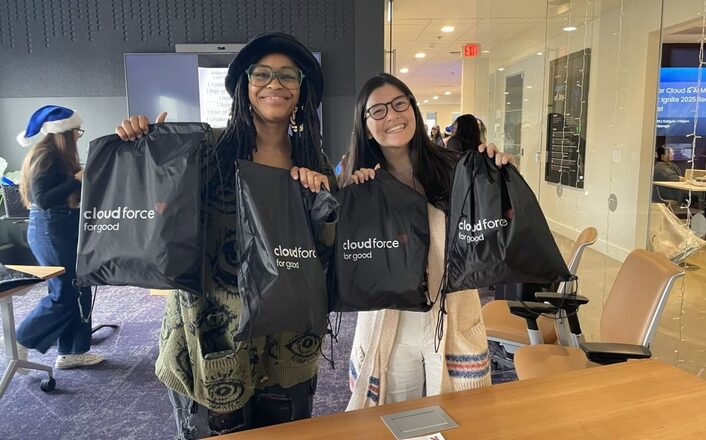
Cloudforce, a Maryland-based frontier AI company, has closed a $10 million Series A funding round as demand accelerates for secure, institution-wide generative AI platforms across education, healthcare, and the public sector. The investment deepens Cloudforce’s commercial and technical alignment with Microsoft and reinforces enterprise confidence in its flagship platform, nebulaONE.
The round was led by Owl Ventures, the world’s largest venture capital fund focused exclusively on education technology, with strategic participation from M12, Microsoft’s venture fund.
The funding arrives during a period of rapid growth for Cloudforce. The nebulaONE platform is now used by more than three million users across 90 institutions globally, including major universities in North America and Europe. Deployments are continuing at a steady pace, with new organizations onboarding weekly. While higher education remains the company’s core market, Cloudforce is increasingly expanding into healthcare and the public sector, following its recent HIPAA certification and the onboarding of its first healthcare customers earlier this year.
Cloudforce positions nebulaONE as foundational infrastructure rather than a point solution. Built exclusively on Microsoft Azure, the platform enables organizations to deploy multiple leading AI models – such as those from OpenAI, Anthropic, and Meta – inside their own private cloud environments. This “bring-your-own-model” architecture is designed to address one of the primary barriers to enterprise AI adoption: the tension between innovation and compliance. By keeping data within institutional cloud tenants, nebulaONE allows organizations to meet strict regulatory requirements around privacy, sovereignty, and security, including FERPA, HIPAA, and GDPR, while maintaining control over costs and usage.
Universities have emerged as early adopters of this approach, as they face growing pressure to provide students and faculty with access to generative AI tools without exposing sensitive academic or personal data. At institutions such as the University of Oxford, nebulaONE has been deployed to support responsible, campus-wide AI use rather than fragmented experimentation through individual subscriptions or consumer-grade tools. Education leaders increasingly view AI not as a future capability but as an immediate operational requirement that must be governed at scale.
For investors, Cloudforce’s appeal lies in its ability to bridge advanced AI capabilities with the realities of regulated environments. Owl Ventures has highlighted the company’s focus on infrastructure over isolated use cases, arguing that sustainable AI adoption in education requires platforms that can support entire institutions rather than individual departments. The firm points to Cloudforce’s growing institutional footprint, accelerating sales velocity, and strong revenue growth as indicators that the model is resonating with large, complex organizations.
Microsoft’s participation through M12 further strengthens Cloudforce’s position. Beyond capital, the investment provides access to Microsoft’s enterprise sales organization and product teams, supporting Cloudforce’s global go-to-market strategy. The partnership builds on an existing relationship that recently saw Cloudforce named Microsoft’s 2025 Education Partner of the Year, distinguishing it among hundreds of thousands of partners worldwide. From Microsoft’s perspective, nebulaONE addresses what it views as a “last-mile” challenge in enterprise AI: translating powerful models into secure, compliant, and deployable assets for large institutions.
Looking ahead, Cloudforce plans to use the Series A funding to expand internationally, grow its workforce in 2026, and develop vertical-specific AI agents tailored to education and healthcare workflows. The company also intends to deepen its public sector presence, where similar concerns around data governance and equitable access are driving interest in private AI environments. Cloudforce’s business model combines platform deployment with consulting, organizational change management, and forward-deployed engineering support, an approach that has contributed to a reported 100 percent subscriber retention rate in 2025.
As generative AI adoption continues to move from experimentation to operational necessity, Cloudforce’s latest funding round reflects a broader shift in the market. Institutions are increasingly prioritizing platforms that balance accessibility with control, enabling widespread AI use without sacrificing trust, compliance, or long-term sustainability.
Executive Insights FAQ
Why are institutions moving toward private AI platforms instead of public tools?
Private platforms allow organizations to retain control over data, comply with regulations, and manage costs more predictably.
What differentiates nebulaONE from other AI platforms?
Its ability to deploy multiple leading AI models within an organization’s own cloud tenant sets it apart from single-model or consumer-focused tools.
Why is Microsoft’s involvement strategically significant?
The partnership provides enterprise credibility, technical integration, and access to global sales channels.
How is AI adoption evolving in higher education?
Universities are shifting from isolated pilots to institution-wide deployments governed by security and policy frameworks.
What markets represent the next growth phase for Cloudforce?
Healthcare and the broader public sector are emerging as key expansion areas due to similar compliance and data sovereignty needs.