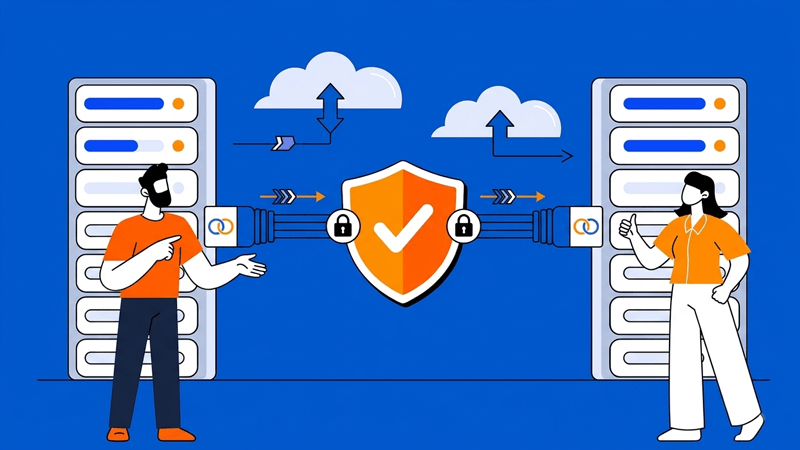
When internal traffic shares the wrong path, server performance and security both become harder to control. Public connectivity is necessary for websites, apps, and user access, but backend traffic such as database replication, storage sync, internal APIs, and cluster communication usually needs a more isolated route. That is where private network interconnects become important. They help businesses keep sensitive server-to-server traffic away from the public internet while improving latency, consistency, and control.
What private network interconnects are
Private network interconnects are isolated connections between servers, systems, or sites that allow internal data to move securely without relying on the public internet as the normal transport path. Depending on the architecture, this can be delivered through a private VLAN, a direct physical link, a private backbone between data centers, or a controlled private routing environment.
Instead of sending every packet through public routes, businesses can separate internal communication from public-facing traffic. This is especially useful for workloads that depend on constant east-west traffic between servers.
Tip: Keep public access and internal traffic on separate paths whenever possible.
Why they matter for secure server communication
Encryption alone does not solve every infrastructure risk. A VPN can protect traffic in transit, but it still depends on public internet conditions. That means route quality, congestion, and latency can still vary. A private network interconnect improves security by reducing exposure at the path level, not just the packet level.
For applications that process sensitive records, financial transactions, customer data, or storage replication, this creates a more controlled environment. It also helps reduce the chance of unpredictable slowdowns caused by external network conditions.
How they work in practice
Most private networking setups separate traffic into two layers. One layer handles public requests, and the other handles internal server communication. A server may use its public interface for website traffic while using a second interface or private VLAN for database access, backup traffic, or application syncing.
This design improves both security and performance because internal traffic no longer competes in the same way with public-facing workloads. In larger deployments, private groups can also extend across multiple racks or data centers.
Tip: If servers communicate constantly, private traffic design matters as much as CPU or storage selection.
Private interconnects vs VPN
VPN and private interconnects are related, but they are not the same. A VPN creates encrypted tunnels over public infrastructure. A private interconnect uses isolated or dedicated connectivity for backend communication.
- VPN is best for remote access, branch connectivity, and lighter secure traffic
- Private interconnect is better for low-latency server communication, replication, and critical internal workloads
In many environments, both are used together. The VPN handles user access, while the private interconnect handles machine-to-machine traffic.
Main benefits
Private network interconnects improve more than privacy. They also help infrastructure behave more predictably under production load. Lower latency, cleaner segmentation, and more stable throughput all matter when systems depend on continuous internal communication.
For distributed applications, private links can reduce routing overhead and give teams more control over how sensitive traffic flows between workloads. That becomes especially important in clustered databases, storage platforms, Kubernetes environments, and analytics systems.
Tip: A stable private path often solves problems that public bandwidth upgrades do not fix.
Common deployment models
The best interconnect model depends on workload design and server location. If flexibility is the priority, a private VLAN is often the most practical option. If the servers are in the same rack and need the lowest possible latency, a direct physical interconnect may be the better fit. For more advanced deployments, a dedicated private switch or cross-data-center private network may be needed.
These designs are often used for:
- database replication
- storage synchronization
- internal APIs
- cluster communication
Why multi-data-center private networking matters
High availability is no longer only about redundant disks or backup power. It also depends on how well systems communicate across locations. A private interconnect that spans multiple data centers allows businesses to replicate data, separate services, and support failover strategies without sending critical backend traffic over public routes.
This makes private networking valuable for disaster recovery planning, active-passive deployments, and distributed application design. It also helps reduce single points of failure in infrastructure that must remain available during hardware or site-level incidents.
What to check before choosing a solution
Not every workload needs the same kind of interconnect. The right choice depends on traffic volume, latency sensitivity, geography, and security requirements. A simple private VLAN may be enough for one deployment, while another may need cross-site private routing or direct physical connectivity.
Look at:
- server location
- traffic type
- growth expectations
- compliance requirements
A provider’s network design also matters. Private networking performs better when it sits on top of strong switching capacity, clean routing, and dependable infrastructure. Dataplugs supports this with dedicated servers in Hong Kong, Tokyo, and Los Angeles, along with multi-carrier BGP infrastructure, direct China connectivity options, and security services that fit performance-sensitive workloads.
Conclusion
Private network interconnects give businesses a stronger way to manage secure server communication. By separating backend traffic from public internet paths, they improve privacy, reduce latency, and support more predictable application performance. For modern infrastructure, especially where replication, clustering, and sensitive data are involved, that makes a real operational difference.
For businesses building multi-server environments, private communication should be part of the original architecture plan. Dataplugs offers the dedicated infrastructure, regional presence, and network foundation to support these environments with more control and consistency. For more information, visit the Dataplugs website or contact sales@dataplugs.com.