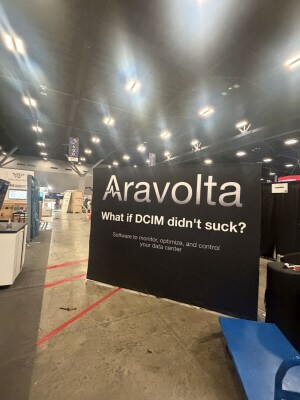
 Aravolta has raised $5.1 million to accelerate the development of a next-generation data center operations platform designed for the AI era, as operators grapple with the operational complexity introduced by GPU-dense infrastructure. The funding highlights growing investor interest in software that can manage the tightly coupled power, cooling, and networking systems underpinning modern AI workloads.
The company positions itself at the intersection of data center infrastructure management (DCIM), electrical power monitoring systems (EPMS), and building management systems (BMS), integrating traditionally siloed operational data into a single, actionable control layer. While DCIM has long been a fixture in large facilities, Aravolta argues that legacy tools were built for more static environments and struggle to cope with the dynamic demands of AI-focused data centers, where even small configuration changes can have cascading effects.
Aravolta is led by CEO Margarita Groisman, CTO Jack Sutton, and COO Pietro Sette. Groisman previously worked on large-scale chip and server deployments inside Microsoft’s data centers, giving her firsthand exposure to the challenges of operating complex, hyperscale environments. Sutton brings experience as a founding engineer across multiple startups, while Sette has led engineering and operations teams at high-growth software companies. Together, the team is focused on automating and optimizing the physical systems that support compute-intensive workloads.
According to Groisman, a new wave of data center operators is discovering that facilities built to support AI are fundamentally different from traditional industrial or enterprise environments. GPU clusters place extreme and variable demands on power and cooling, and infrastructure components are more interdependent than in the past. As a result, operators need real-time visibility and automated decision-making rather than static dashboards or after-the-fact reporting.
‘Moving Beyond Aggregation’
Aravolta’s platform aggregates telemetry from across the facility, including branch circuit monitoring, precision power metering, and environmental systems, and turns that data into operational workflows and controls. The company describes its approach as moving beyond aggregation toward enabling decisions and automated responses, a positioning it has likened to applying data-driven operational intelligence to physical infrastructure.
Early customers include colocation providers, chip manufacturers, edge data center operators, and emerging “neocloud” platforms focused on AI workloads. Named users include OpenColo, Flexnode, DataCrunch, and Centra, alongside additional customers that have not yet been disclosed publicly. These organizations typically operate smaller but more specialized facilities, where efficiency and reliability are critical to maintaining margins and meeting service-level expectations.
The $5.1 million funding round includes backing from venture firms such as Topology, Wishchoff, Crucible, Susa, Afore, and Banyan, as well as Y Combinator and the Pioneer Fund. The round also attracted a group of notable angel investors, including Guillermo Rauch and Nick Hansen, reflecting interest from founders and operators familiar with scaling complex technical systems.
While Aravolta competes in the broad DCIM category, its emphasis on automation and control reflects a broader shift in the data center industry. As AI drives rapid expansion of compute infrastructure, operators are under pressure to deploy capacity quickly while maintaining reliability, energy efficiency, and safety. Software platforms that can reduce operational friction and provide a unified view of facility behavior are increasingly seen as essential rather than optional.
With AI infrastructure investment continuing to rise globally, Aravolta is betting that the next phase of data center innovation will be defined less by hardware alone and more by the software that orchestrates it.
Executive Insights FAQ
Why are AI-era data centers harder to operate than traditional facilities?
GPU-heavy environments place highly variable demands on power and cooling, with tightly coupled systems where small changes can affect overall stability.
What problem is Aravolta trying to solve for operators?
The company aims to unify fragmented operational data and convert it into real-time decisions and automated controls rather than static monitoring.
How is Aravolta different from traditional DCIM platforms?
Its platform integrates DCIM, EPMS, and BMS data into a single control layer designed for dynamic, high-density AI workloads.
Who is adopting this type of software today?
Early adopters include colocation providers, neoclouds, chip manufacturers, and edge data center operators focused on AI infrastructure.
Why are investors backing this category now?
The rapid growth of AI infrastructure has exposed operational gaps that legacy tools cannot address, creating demand for more intelligent control software.