High-performance servers can still underperform when internal traffic moves through congested or unpredictable paths. One application request may pass between web servers, APIs, databases, storage systems, virtual machines, and containers before reaching the user. As these dependencies grow, network design becomes as important as processor speed, memory, and storage.
Spine leaf network topology provides a flatter architecture for heavy server-to-server communication. It creates short, consistent paths, distributes traffic across multiple links, and allows data center capacity to grow without repeatedly redesigning the network.
What spine leaf network topology means
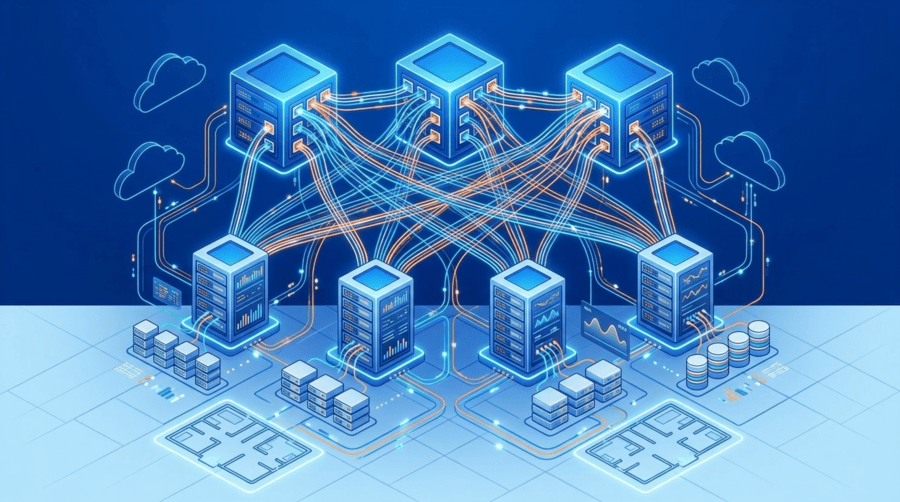
A spine-leaf architecture contains two switching layers. Leaf switches connect dedicated servers, storage systems, firewalls, load balancers, hypervisors, and container nodes. Spine switches form the high-speed backbone connecting all leaf switches.
Every leaf connects to every spine. When servers are attached to different leaf switches, traffic normally follows this route:
Server → leaf switch → spine switch → destination leaf switch → destination server
This design provides multiple routes while keeping switching stages predictable and reducing dependence on one aggregation device.
Tip: Before ordering dedicated servers, confirm private port speeds and whether servers can communicate through an isolated internal network.
Why east-west traffic drives spine-leaf adoption
Traditional network hierarchies mainly supported north-south traffic between users and applications. Modern platforms generate far more east-west traffic between internal systems.
A frontend may contact an authentication service, query a database, update a cache, write logs, and replicate data before responding. Virtual machines also communicate across hosts, while backup systems transfer large files to storage.
Common east-west workloads include:
- database replication
- microservices API calls
- Kubernetes pod communication
- virtual machine traffic
- distributed storage
- backup transfers
In deeper hierarchies, these flows may cross several switching layers and become concentrated around aggregation devices. Spine-leaf provides shorter paths and greater capacity between racks.
How spine-leaf topology improves latency and traffic flow
One of the main advantages of spine-leaf is not only lower latency, but more consistent latency. Endpoints connected to different leaf switches normally follow the same route, with traffic moving from the source leaf through one spine and then to the destination leaf. This is easier to predict than a network where workloads cross different numbers of switches.
Spine-leaf fabrics commonly use equal-cost multipath routing, or ECMP, which allows switches to use several routes with the same routing cost. Because each leaf connects to multiple spines, traffic can be distributed across available uplinks. This improves bandwidth use, helps avoid idle redundant links, and supports resilience if one spine connection fails.
Traffic is usually balanced by flow rather than by individual packet, which helps reduce packet reordering. However, a few large flows can still create uneven utilization. Spine-leaf can also experience delays when uplinks are undersized. Switch buffers, traffic bursts, routing convergence, and server-side processing all affect performance.
Tip: When comparing dedicated servers, ask about latency, private networking, port capacity, and server-to-server traffic inside the data center.
How spine-leaf supports scalability
A spine-leaf fabric can expand in two directions. Additional leaf switches provide more server connections, while increased spine capacity adds bandwidth between leaf switches.
This modular design makes it easier to add servers, storage nodes, virtualization hosts, and application clusters without rebuilding the entire network.
Capacity planning should consider:
- expected server growth
- future uplink requirements
- available spine ports
- rack and power capacity
- fiber and transceiver needs
Every leaf must connect to every spine, so physical limits still apply. Larger environments may use multiple fabric pods or add a super-spine layer.
Understanding oversubscription and redundancy
Spine-leaf does not guarantee that every server can transmit at full speed simultaneously. Performance depends on the ratio between server-facing bandwidth and uplink bandwidth.
For example, a leaf with 1,200 Gbps of server-facing capacity and 800 Gbps of spine uplink capacity has a 1.5:1 oversubscription ratio.
That may suit general web applications because not every server uses its full connection continuously. Storage clusters, AI workloads, distributed databases, and large backup systems may require lower oversubscription or a near-non-blocking design.
The correct ratio should reflect peak usage, replication, backups, and failover events rather than average demand.
With multiple spine switches, the failure of one spine does not normally disconnect the leaf layer. Traffic can continue through the remaining devices. Individual uplinks can also fail without interrupting communication when routing protocols use alternative paths. Critical servers may connect to two leaf switches through network bonding, multichassis link aggregation, or EVPN multihoming.
Multiple switches alone do not guarantee resilience. A reliable design also needs redundant power, diverse cabling, spare transceivers, monitoring, and tested failover procedures.
Tip: Dedicated servers supporting databases, virtualization, or distributed storage may need much more private bandwidth than independent web servers.
How dedicated infrastructure supports the design
The network fabric is only one part of application performance. Server hardware, storage, private connectivity, external routing, security, and data center operations all affect reliability.
Dedicated servers provide predictable processor, memory, storage, and network resources for databases, virtualization platforms, container clusters, and multi-server applications. They also give infrastructure teams greater control over interfaces, operating systems, traffic policies, and workload placement.
Dataplugs provides dedicated servers, CN2 Direct China Server options, Global BGP Server solutions, Anti-DDoS Protection, Web Application Firewall services, backup solutions, and colocation infrastructure. These services support performance-sensitive deployments requiring stable resources and reliable regional or international connectivity.
Before selecting infrastructure, confirm private network availability, interface speeds, bandwidth limits, routing options, redundancy, and technical support coverage.
Conclusion
Spine leaf network topology gives modern data centers a flatter and more predictable way to connect servers, databases, storage systems, virtual machines, containers, and application services. By connecting every leaf switch to every spine switch, it creates short paths that support consistent latency, efficient east-west traffic, scalable capacity, better bandwidth use, and stronger fault tolerance.
Its effectiveness still depends on proper uplink sizing, oversubscription, routing, cabling, monitoring, and redundancy planning. A poorly sized fabric can still experience congestion, uneven traffic distribution, and avoidable service interruptions.
For distributed applications, database clusters, virtualization platforms, and storage-intensive workloads, a properly planned spine-leaf network provides a stable foundation for long-term growth. For more information, visit the Dataplugs website or contact sales@dataplugs.com.