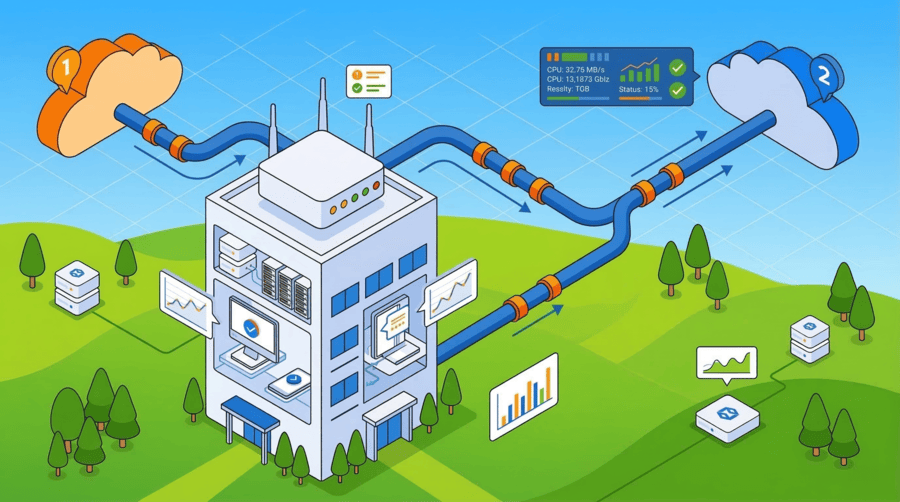
Network disruptions rarely originate from hardware failure alone. In many situations, service interruptions occur because connectivity depends on a single upstream network. A routing issue inside an ISP, congestion along a transit path, or a regional carrier outage can suddenly isolate applications from users. For organizations operating SaaS platforms, ecommerce systems, or high traffic web services, maintaining stable internet reachability becomes a critical part of server architecture.
BGP multi homing addresses this challenge by connecting servers to multiple upstream networks and using the Border Gateway Protocol to manage routing decisions. Instead of relying on one path to reach the internet, traffic can move through multiple routes, allowing services hosted on dedicated servers to remain reachable even when one provider encounters problems.
Understanding How BGP Controls Internet Routing
The global internet operates as a collection of interconnected networks known as Autonomous Systems. Internet service providers, cloud platforms, enterprise networks, and hosting environments exchange routing information between these systems through the Border Gateway Protocol.
BGP evaluates routing attributes such as AS path length, local preference, and policy rules to determine how traffic should travel across networks. When one route becomes unavailable or unstable, routers update their routing tables and select alternative paths.
Because BGP continuously exchanges reachability information between networks, routing decisions can adapt automatically when connectivity conditions change. This dynamic behavior is what enables resilient connectivity across the internet.
What BGP Multi Homing Means for Dedicated Server Deployments
Multi homing refers to connecting a network to more than one internet provider at the same time. Instead of a single ISP acting as the only gateway to the internet, the network establishes BGP sessions with multiple upstream carriers.
When a server network advertises its IP address ranges through each provider, external networks learn that the destination can be reached through several routes. If one connection fails, traffic continues flowing through the remaining providers without requiring manual intervention.
This design introduces BGP multi homing redundancy, eliminating the single point of failure common in single carrier server environments.
How BGP Multi Homing Improves Network Resilience
Applications hosted on dedicated servers rely on uninterrupted connectivity. Even short disruptions can prevent users from reaching websites, APIs, or online services.
Multi homed networks improve resilience by allowing routing decisions to adjust automatically. When an ISP connection fails, the BGP session withdraws those routes and traffic shifts to another available provider. This process enables BGP multi homing failover.
For services that require continuous uptime such as SaaS platforms, ecommerce stores, or financial systems, automatic failover significantly reduces service interruption.
Traffic Control and Routing Optimization
Another advantage of BGP is the ability to control how traffic moves across different network paths. Engineers can adjust routing attributes such as local preference or AS path to influence which carrier handles certain traffic flows.
This allows organizations to optimize routing for latency, regional connectivity, or bandwidth availability. For example, traffic heading toward certain regions may use a carrier with stronger network presence in that area.
This level of routing control is one of the key benefits of BGP multi homing routing, allowing server deployments to maintain stable performance across diverse internet paths.
Why Multi Homed Connectivity Improves Internet Reliability
Internet outages typically affect specific providers or network segments rather than the entire internet. A fiber cut, routing error, or congestion event may disrupt one carrier but leave other networks unaffected.
Single homed server deployments rely entirely on one provider, meaning any upstream issue can cause service disruption. With BGP multi homing internet reliability, connectivity is distributed across multiple carriers. If one network path becomes unstable, traffic shifts toward another provider whose route remains healthy.
This diversification significantly reduces the likelihood that a single network incident will interrupt access to hosted services.
Infrastructure Considerations for BGP Multi Homing
Deploying multi homed connectivity usually requires an Autonomous System Number and a routable IP address block that can be announced to multiple providers.
Edge routers establish BGP sessions with upstream carriers and apply routing policies that influence traffic behavior. Network administrators also configure route filtering and prefix limits to maintain routing stability.
Equally important is physical network diversity. Independent carriers and separate network paths help ensure that failures in one provider’s infrastructure do not affect all connectivity.
The Role of Network Quality in Dedicated Server Hosting
Routing intelligence is only one part of maintaining stable connectivity. The network architecture behind dedicated servers must also support carrier diversity and high capacity bandwidth.
Dedicated server providers with multi carrier connectivity and strong upstream networks can deliver more reliable routing paths for hosted workloads. This helps ensure that applications remain reachable even when internet conditions change.
Providers such as Dataplugs operate dedicated server environments connected to multiple upstream carriers across major Asia Pacific network hubs. This approach allows businesses running SaaS platforms, ecommerce systems, and high traffic web services to maintain consistent connectivity while benefiting from reliable dedicated server performance.
Conclusion
Reliable connectivity depends on more than raw bandwidth. Maintaining stable access to hosted applications requires routing flexibility and the ability to adapt when network paths fail.
BGP multi homing improves network resilience by connecting server networks to multiple internet providers, allowing traffic to shift dynamically between available routes. Through automatic failover, intelligent routing policies, and diversified connectivity, organizations can reduce downtime and maintain stable access to their services.
For businesses deploying dedicated servers that require consistent global reachability, multi homed network design plays an important role in ensuring dependable connectivity. To learn more about dedicated server solutions and network capabilities, connect with the team via live chat or at sales@dataplugs.com.