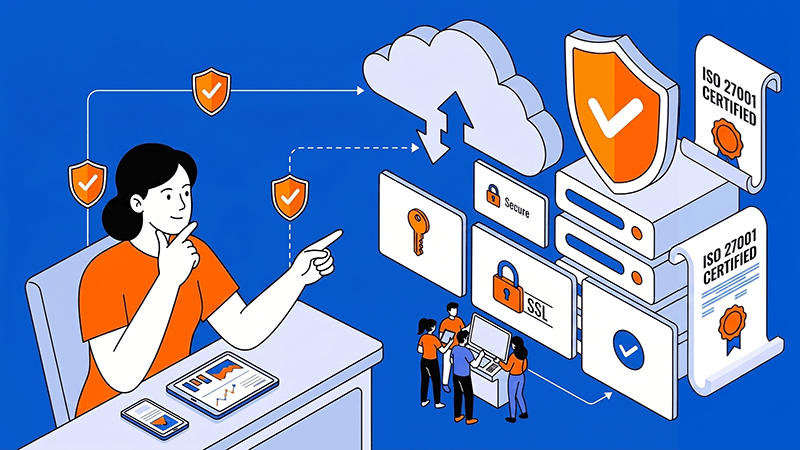
When a hosting environment struggles during a security review, the root issue is usually not the server itself. It is the lack of clarity around who controls what, how access is restricted, how systems are monitored, and how sensitive workloads are separated from unnecessary exposure. In ISO 27001 terms, controls only become useful when they can be translated into actual hosting decisions. That is why understanding Annex A from a hosting perspective matters. It helps turn compliance language into infrastructure design, operational discipline, and audit-ready security practices.
For businesses running customer portals, ecommerce platforms, internal systems, SaaS applications, or regulated workloads, this is not just about documentation. It is about building a hosted environment where confidentiality, integrity, and availability are supported by clear access rules, reliable monitoring, backup protection, supplier governance, and resilient network design. In dedicated hosting, this is often easier to enforce because the environment can be structured around the workload rather than fitted into a general-purpose setup.
Why hosting changes how ISO 27001 controls are applied
ISO 27001:2022 includes 93 Annex A controls across four areas: organizational, people, physical, and technological. From a hosting perspective, the challenge is not understanding the list. The challenge is understanding how those controls apply to real infrastructure.
A hosted environment introduces a shared responsibility model. The provider may handle the facility, network, hardware, or perimeter protection, while the customer remains responsible for operating system hardening, user access, application security, and data governance. If that split is vague, controls may be assumed rather than enforced. That creates gaps that are difficult to spot until an incident or audit exposes them.
Start with shared responsibility
The most practical way to understand ISO 27001 in hosting is to define what the provider covers and what remains with your internal team. This is especially important for supplier security, cloud-related controls, incident response, and continuity planning.
A provider may support infrastructure-level functions such as network availability, hardware replacement, data center security, and DDoS mitigation. The customer may still own account management, log review, system patching, data classification, and application-layer controls. When these roles are documented early, the control environment becomes much easier to manage and explain.
Tip: If a provider supports a control, make sure your team still knows how to verify it when evidence is needed.
Organizational controls become hosting governance
Annex A.5 controls shape how hosted infrastructure is governed. This includes policies, asset inventory, ownership, supplier management, cloud service oversight, incident procedures, and business continuity planning. In hosting, these controls are what connect the ISMS to actual workloads.
A stronger environment usually starts with knowing which systems are in scope, who owns them, how they are classified, and what third-party dependencies support them. This becomes easier when workloads are hosted in clearly defined infrastructure rather than spread across loosely managed environments. Dedicated hosting helps here because system boundaries, traffic paths, and administrative ownership are often clearer.
People controls affect hosting more than expected
Many hosting weaknesses begin with people rather than technology. Broad administrator access, weak offboarding, shared credentials, poor remote access discipline, and limited awareness of phishing can all undermine an otherwise well-designed environment.
People controls in Annex A.6 address that by focusing on screening, awareness, employment obligations, remote working security, and privileged access discipline. In hosting, these controls matter most wherever individuals can make high-impact changes to live systems.
Administrative access should be limited, named, approved, and reviewed. Staff who manage hosted systems should understand both security expectations and escalation procedures. If access is still based on convenience, the environment is carrying more risk than it appears.
Tip: Privileged access should be isolated, reviewed regularly, and never treated as permanent by default.
Physical controls still matter in hosted environments
Even when workloads run in professional data centers, physical controls remain relevant. ISO 27001 still expects businesses to consider access to equipment, environmental protection, media handling, and secure disposal. In hosting, this often means relying on provider controls while ensuring they are understood well enough to support your own risk assessment and supplier review.
A professionally managed facility can strengthen the overall control posture by providing restricted access, power resilience, environmental safeguards, and controlled equipment handling. That reduces the burden on internal teams and helps support more consistent evidence during reviews.
Technological controls are where hosting design becomes visible
Annex A.8 controls are often the most visible in hosted environments because they shape how systems are protected day to day. Access control, secure configuration, malware protection, monitoring, backup, authentication, vulnerability management, and network security all directly influence how defensible the environment is.
This is where hosting design starts to show whether security is intentional. If public services, databases, backups, and admin access all sit too close together, control strength drops quickly. If they are separated and monitored with purpose, the environment becomes easier to operate and easier to justify.
- Restrict management access by source, role, and authentication method
- Separate public traffic, backend services, and backup paths
- Centralize logs so incidents can be detected and explained more easily
- Review vulnerabilities and patch status on a defined schedule
Access control should follow workload boundaries
Access control is one of the clearest ways ISO 27001 translates into hosting. A server environment should not give broad access simply because it is operationally convenient. Users and admins should only reach the systems and functions they actually need.
That usually means applying MFA, separating privileged and standard accounts, restricting SSH or RDP exposure, and reviewing access rights routinely. In dedicated environments, this becomes more practical because policies can be tailored around the actual workload and network path rather than inherited from a broader shared platform.
Tip: If every admin can reach every server, access control is probably broader than the business really needs.
Monitoring and backups should support recovery, not just reporting
Logging and monitoring are often treated as technical housekeeping, but in ISO 27001 they support detection, investigation, and control assurance. Hosted workloads should produce meaningful visibility into access events, system changes, service failures, and abnormal activity. Logs should be retained in a way that supports both operational review and incident analysis.
Backups deserve the same level of discipline. A backup that is easily reachable from the production environment may not hold up well during ransomware or account misuse. Stronger recovery design usually depends on separated backup paths, restricted access, defined retention, and regular recovery testing.
For businesses that need tighter control over infrastructure layout, traffic flow, and security layering, dedicated hosting can support a cleaner control design. Dataplugs provides dedicated server hosting in Hong Kong, Tokyo, and Los Angeles, supported by global BGP connectivity, CN2 Direct China connectivity, Anti-DDoS protection, firewall protection, and WAF services. That foundation helps businesses build environments that are easier to secure, monitor, and align with compliance expectations.
Why dedicated hosting can support ISO 27001 readiness
Dedicated hosting does not automatically make an environment compliant, but it often makes control implementation more practical. Clearer workload separation, better-defined access paths, and stronger control over network design can all help reduce ambiguity. That matters when the goal is not only to run systems well, but to show that access is intentional, risks are reviewed, and recovery is realistic.
For businesses with compliance-sensitive workloads, this can lead to cleaner scope definition, more predictable evidence gathering, and a more structured approach to security operations. Dataplugs supports this through enterprise-grade dedicated server hosting, security-focused network options, and infrastructure services that fit operational and compliance planning without making them harder than they need to be.
Conclusion
To understand ISO 27001 controls from a hosting perspective, it helps to stop viewing them as a checklist and start reading them as infrastructure expectations. Shared responsibility, administrative access, traffic separation, supplier oversight, physical resilience, monitoring, and recovery are all part of how a hosted environment becomes more secure and more defensible.
The goal is not only to satisfy a review. It is to build a hosting environment where controls are visible in the way systems are designed and operated. That is what makes security easier to manage over time and easier to explain when scrutiny increases.
For more information, visit Dataplugs or contact sales@dataplugs.com.