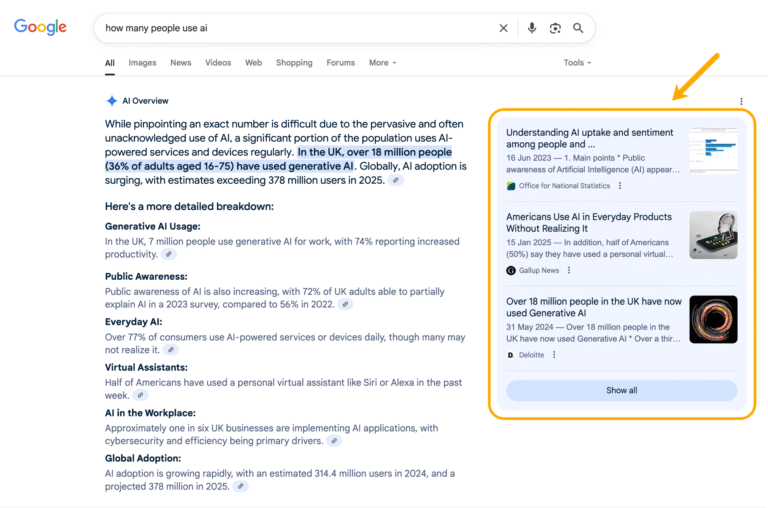
I still have plenty of questions about how Google treats AI-generated content.
On the one hand, Google says they don’t care whether AI is used for content creation, as long as the content isn’t designed “with the primary purpose of manipulating ranking in search results.”
Automation has long been used in publishing to create useful content. AI can assist with and generate useful content in exciting new ways.
On the other hand, people like Lily Ray and Glenn Gabe have shared many examples of so-called “mount AI” traffic graphs: websites that scaled content creation with AI, saw a heroic spike in rankings and traffic… and then watched their organic performance tank a few months after publication.
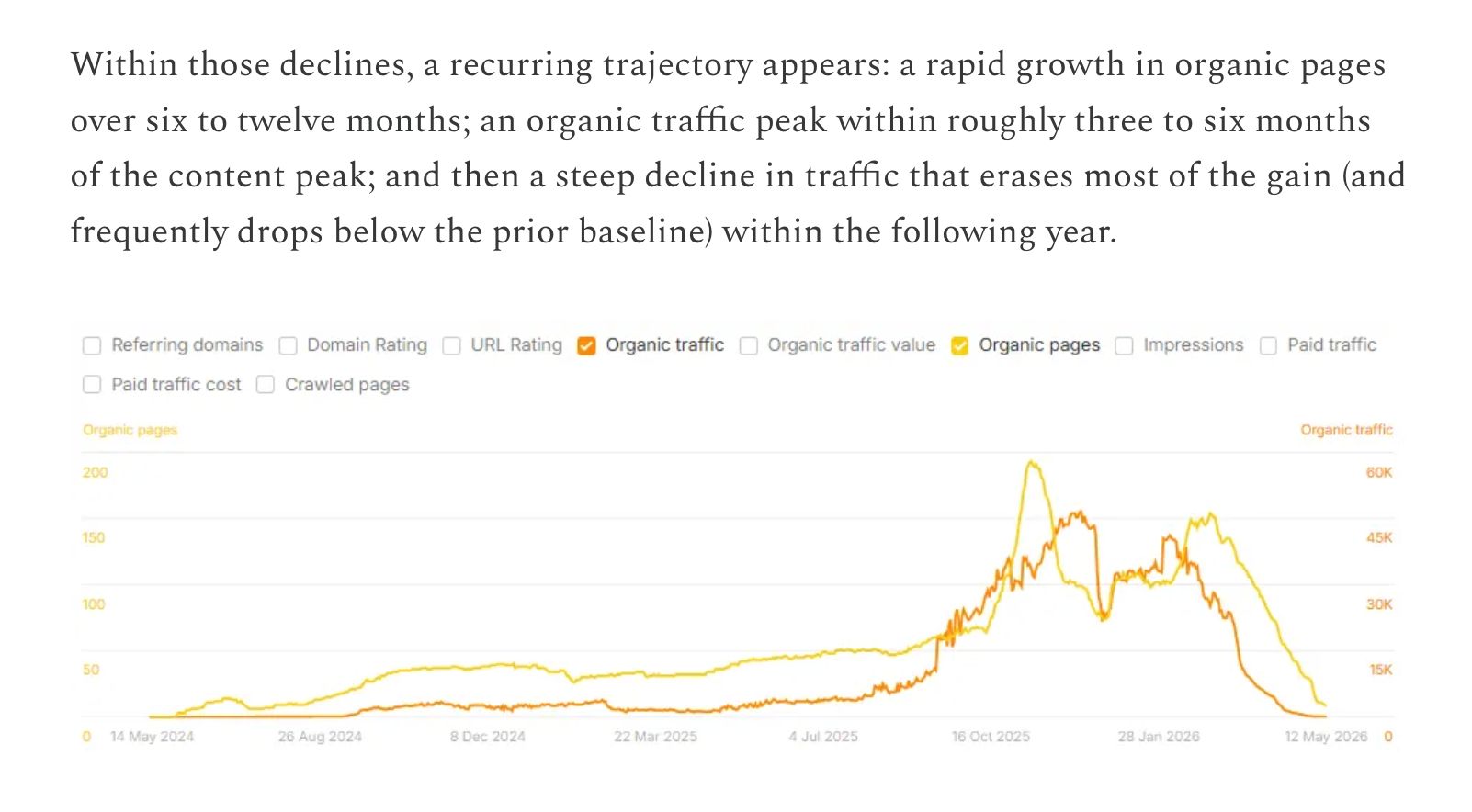
An example of a “Mount AI” traffic graph from Lily’s article.
Many marketers are now unwilling to use generative AI in any capacity for fear Google will punish them. But is Google punishing these websites for using AI content? Or is their AI use incidental to the fact that they’re making spammy, scaled content?
We set out to answer four questions that might shed some light on the issue:
- Are there any fully AI-generated pages in top-ranking positions?
- How common is AI-generated content throughout the top 10?
- Does Google index content with a very high likelihood of being AI?
- Does the organic performance of AI-generated content tank within a few months?
Based on this research, I believe that Google is not against AI content; it is against bad content, but confusion arises because AI content and bad content overlap a significant amount of the time.
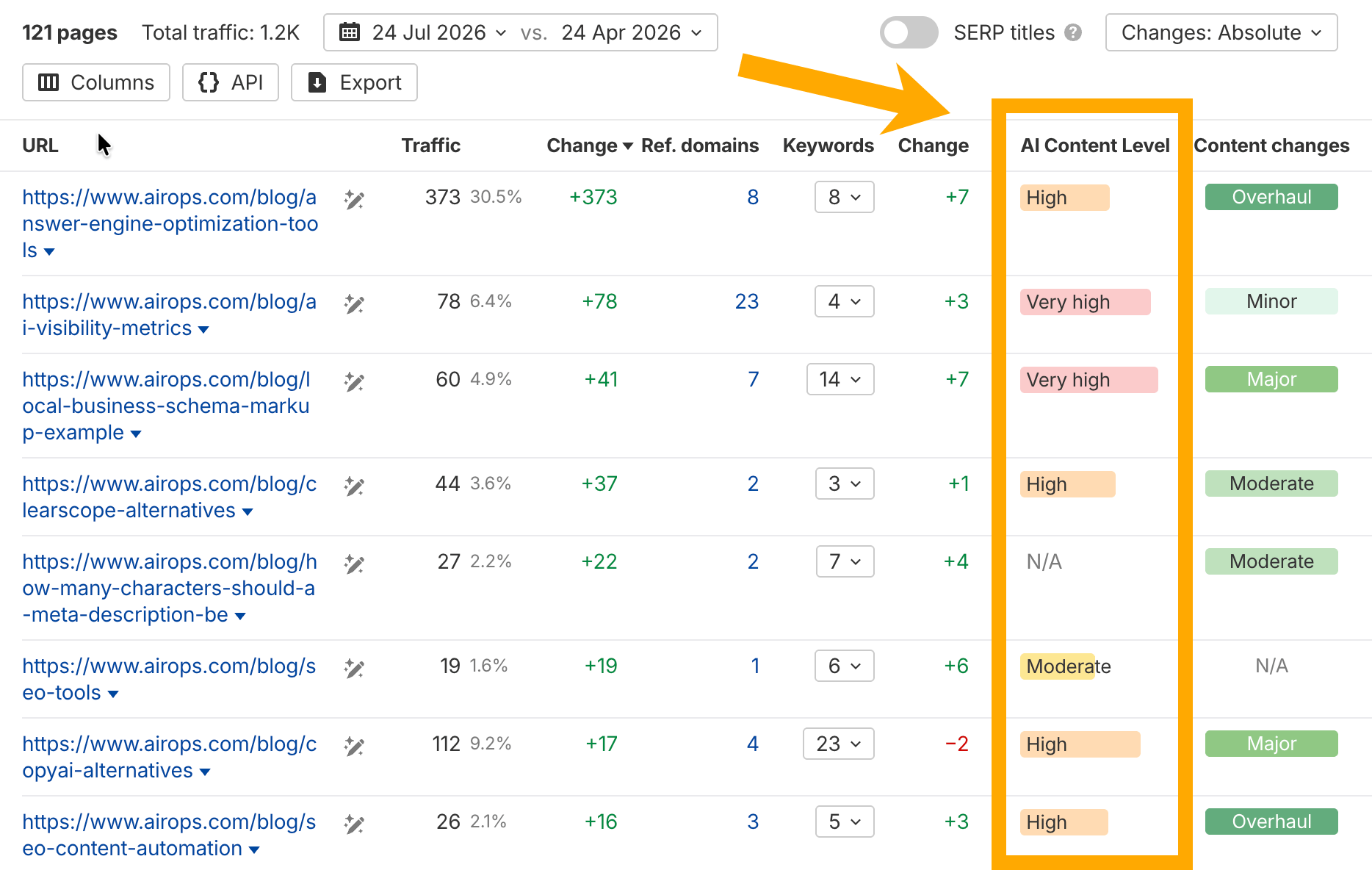
AI content levels indicate the estimated percentage of AI-generated text on the page, ranging from low (<20%) to very high (≥80%). For greater accuracy, AI detection only triggers on pages at least 350 words in length.
Importantly, AI content detection is not perfect, and the way we detect AI content will be different from how Google does (if it does).
In the same way that an LLM uses probability to generate text, AI detectors use probability to classify it. This type of research is, in my opinion, the best way to use AI content detection: looking at large-scale datasets and directional trends, and not fixating on individual articles and their AI content.
Further reading
- Repeats common knowledge without adding any new information to the SERP.
- Fails to include internal and external links, images, visual interest, and first-person experiences.
- Relies on tedious academic-style writing.
- Contains obvious mistakes and inaccuracies.
These are all problems that could markedly worsen the organic performance of any piece of content, but they are especially common in most AI-generated content. As Dan Taylor explained in his great SEJ article recently, publishing this content at scale is the perfect recipe for your very own “Mount AI” situation, as Google “burst-crawls” new low-quality, AI-generated pages but dumps them from the index soon after:
Google might initially burst-crawl the new setup out of curiosity. But, if the domain lacks the baseline authority to sustain that scale, Google will throttle its resource allocation. Just because Google gives you the resources to index your pages initially, it does not mean it will grant them to you indefinitely.

I don’t think Google is trying to punish AI-generated content; I think it is relying on the same old hallmarks of content quality that it always has. It’s just that AI-generated content is usually lower quality than human-generated content.
Crucially, these quality problems commonly co-occur with AI use, but they are not guaranteed by AI use—as shown by the not-insignificant number of indexed and top-ranking AI-generated pages. I know from firsthand experience that it is very possible to create detailed, interesting, well-researched content using AI generation—the caveat being that most people do not. Yet.
I don’t believe marketers and SEOs should be scared of AI content creation—but they should be scared of spam and scaled content.
Further reading
Similar Posts
Tangem Wallet Q&A + SUMMER SALE!
🚨 Get 20% OFF your entire Tangem order using code CYBERSCRILLA at checkout! Or tap this…
How to See WPBeginner Articles First in Google (In 2 Clicks)
If you love WordPress and rely on WPBeginner for tutorials, tips, and guides, then we want…
Passphrase Wallet Explained in 60 seconds!
A passphrase is the easiest way to protect your crypto cold wallet. Here’s everything you need…
76% of AI Overview Citations Pull From Top 10 Pages
How much do traditional and AI search results overlap? AI models draw on search engine indexes…
5 Smart Ways to Spy On Your Competitors’ Ads
Most marketers approach competitor analysis with the wrong mindset. They see a successful ad and think,…
DON’T Use These Hardware Wallets!
• Get Tangem (20% off): https://tangem.com/pricing/?promocode=CYBERSCRILLA&promocode=BLOOMX26 • Get Ledger ($10-$20 free Bitcoin): https://shop.ledger.com/r/cyber-scrillar=f3f59e340ecb • Get Trezor…