High bandwidth connections do not automatically guarantee fast data transfers across continents. Many organizations discover that even with gigabit infrastructure, large file transfers still move slower than expected when distance increases. The underlying reason is often how TCP regulates the amount of data that can be sent before waiting for acknowledgment.
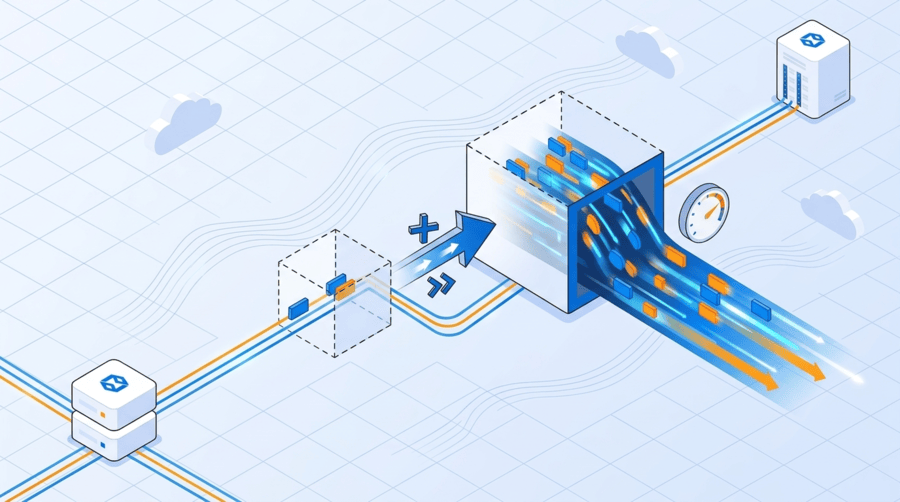
TCP window scaling expands this limit, allowing significantly more data to remain in transit across the network. For global workloads such as data replication, large media distribution, or backup synchronization, this mechanism plays a critical role in maintaining stable transfer speeds across high latency routes.
TCP Window Scaling Explained
TCP window scaling is an extension to the Transmission Control Protocol that increases the maximum receive window beyond the original 65,535 byte limit. In a standard TCP connection, the receiver advertises how much data it can accept before sending an acknowledgment back to the sender.
This limit was reasonable when TCP was first introduced, but modern networks operate at speeds far beyond what the original design anticipated. A small receive window can be filled almost instantly on today’s high speed links, forcing the sender to pause while waiting for acknowledgments.
To solve this, TCP window scaling introduces a multiplier negotiated during the TCP three way handshake. The window value is then multiplied by a scaling factor, allowing the effective window size to expand into the megabyte range.
Note: TCP window scaling was introduced through RFC 1323 to help TCP operate efficiently on high bandwidth and long delay networks.
Why TCP Window Scaling Matters for Long Distance Networks
The impact of tcp window scaling long distance becomes clear when examining how latency affects throughput. TCP can only send a certain amount of data before it must wait for acknowledgment packets to return from the receiver.
On intercontinental routes where round trip time may exceed 100 milliseconds, this waiting period becomes significant. If the receive window is too small, the sender spends much of the transfer waiting rather than transmitting.
By allowing a much larger window size, scaling enables more data to travel simultaneously. This keeps the network pipeline full and helps maintain steady throughput even when latency is unavoidable.
TCP Window Scaling and High Speed Transfers
High performance transfers depend on maintaining a large amount of in flight data. The amount required is determined by the bandwidth delay product, which represents how much data must be present in the network to fully utilize the available bandwidth.
For example, a 10Gbps connection with 100ms latency requires more than 100MB of data in transit to reach full capacity. Without scaling, a TCP window limited to 64KB cannot sustain that level of throughput.
With tcp window scaling high speed transfers become much more efficient because the sender can continuously stream packets without frequent pauses.
Tip: If your application distributes large files, game updates, media assets, or software downloads globally, deploying dedicated servers with high bandwidth ports such as 10Gbps helps maintain stable throughput once TCP window scaling and buffering are properly configured.
TCP Window Size Optimization and System Behavior
Most modern operating systems support automatic tcp window size optimization. Instead of using fixed window values, the system dynamically adjusts the receive window based on available memory, network conditions, and observed latency.
Other TCP features also contribute to improved performance:
- Selective Acknowledgments allow missing packets to be retransmitted without resending entire data streams
- TCP timestamps improve round trip time measurement accuracy
- Fast retransmit allows lost packets to be recovered more quickly
Together, these mechanisms help TCP adapt to real world network conditions while maintaining reliable data delivery.
Understanding TCP Throughput in High Latency Environments
The relationship between tcp throughput high latency is one of the most important factors affecting global data transfers. As latency increases, the time required for acknowledgment packets also increases.
TCP uses congestion control algorithms to protect the network from overload. When packet loss occurs, the protocol reduces its transmission rate until stability is restored. On long distance links, this behavior can reduce throughput even when bandwidth remains available.
Because of this, network performance across continents often depends on a combination of protocol tuning, buffer capacity, and routing efficiency.
Note: Large transfers across international routes may experience throughput limits if the TCP window size is smaller than the bandwidth delay product of the connection.
Infrastructure Considerations for Large Scale Data Transfers
Beyond protocol settings, the surrounding network environment has a major influence on transfer performance. Routing paths, carrier connectivity, and data center network design all affect how efficiently packets move across the internet.
Infrastructure connected to major internet exchange points typically offers better international routing and reduced packet loss. Multi carrier connectivity can also improve stability by allowing traffic to follow alternative network paths when congestion occurs.
Tip: Businesses serving users across Asia Pacific or distributing content internationally often benefit from dedicated servers located near major internet hubs with strong upstream connectivity. This reduces routing inefficiencies and improves consistency for long distance transfers.
Supporting High Throughput Workloads with the Right Infrastructure
For businesses running bandwidth intensive services, network infrastructure becomes just as important as protocol optimization. Large scale file delivery, content distribution platforms, and global backup systems all require stable connectivity and sufficient bandwidth capacity.
Deploying dedicated servers with high network throughput, strong upstream carriers, and reliable routing paths can significantly improve how TCP performs in real world environments. Locations connected to major internet exchange hubs often experience lower latency and more consistent international routing.
Providers such as Dataplugs offer dedicated server infrastructure designed for high bandwidth workloads, with connectivity in key Asia Pacific network hubs. This type of environment helps organizations maintain stable transfer performance for global applications, large scale downloads, and cross region data movement.
Tip: When selecting infrastructure for high transfer workloads, consider factors such as port speed, carrier diversity, and proximity to major internet exchanges. These elements can influence transfer consistency as much as protocol configuration.
Frequently Asked Questions
What is TCP window scaling explained in simple terms?
TCP window scaling allows a network connection to send more data before waiting for acknowledgment. Instead of being limited to a small receive window, scaling multiplies the window size so more packets can remain in transit. This improves transfer efficiency on modern high bandwidth networks.
How does TCP window scaling help long distance transfers?
Long distance connections introduce higher round trip time. Without scaling, TCP must frequently pause while waiting for acknowledgments. TCP window scaling increases the amount of in flight data, helping the connection maintain higher throughput across high latency routes.
Why does TCP throughput drop in high latency networks?
TCP throughput is influenced by the relationship between window size and latency. When latency increases but the receive window remains small, the sender cannot transmit enough data to fully utilize the connection. Expanding the window size helps reduce this limitation.
Conclusion
TCP window scaling helps modern networks overcome the limitations of the original TCP window size by allowing far more data to remain in transit during a connection. This capability significantly improves performance for long distance high speed transfers where latency would otherwise limit throughput.
For organizations managing global workloads, understanding tcp window scaling explained provides insight into why transfer speeds may fall short of available bandwidth. When combined with proper tcp window size optimization and well connected infrastructure, scaling allows TCP to operate far more efficiently across long distance networks.
If your workloads involve global data distribution, large file delivery, or bandwidth intensive applications, infrastructure design plays a major role in maintaining consistent transfer speeds. To learn more about dedicated server solutions and high bandwidth connectivity, connect with the team via live chat or at sales@dataplugs.com.