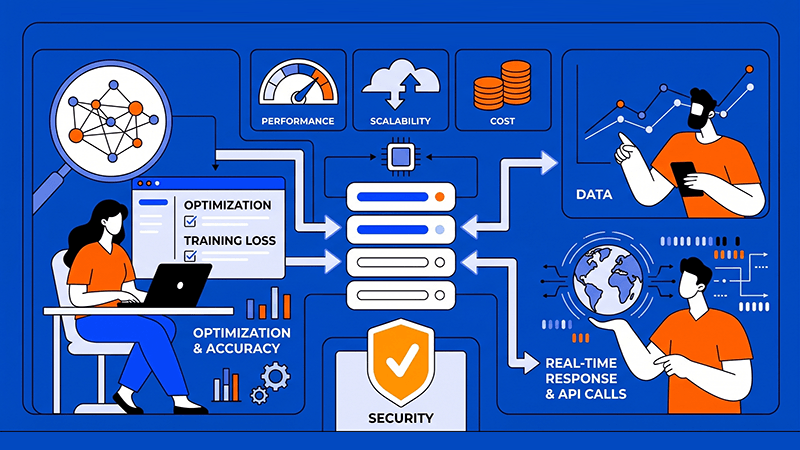
Once AI workloads move beyond testing, infrastructure decisions start affecting delivery speed, scaling flexibility, operating cost, and service stability. At that stage, evaluating hardware is no longer just about comparing GPU models or processor specifications. The better question is how the full environment performs for actual training and inference use cases. That includes compute, memory, storage, network, software compatibility, and deployment model.
Why evaluation should start with the workload
The right hardware environment depends first on workload behavior. Training and inference may use the same model, but they create different demands.
Training usually involves repeated data passes, model updates, and longer compute jobs. Inference is more often shaped by latency, throughput, concurrency, and response consistency.
Before comparing hardware, it helps to ask:
- is the environment mainly for training, inference, or both
- is inference real time, batch based, or streaming
- which frameworks are required, such as PyTorch, TensorFlow, JAX, or ONNX
- will deployment run in cloud, dedicated servers, edge, or a hybrid setup
- is the workload still changing often, or already stable and repeatable
These questions usually lead to better decisions than raw benchmark numbers alone.
Why training and inference should be reviewed separately
Training and inference should be planned as separate infrastructure tasks.
Training benefits from high compute capacity, fast data transfer, and efficient scaling across accelerators. Inference is usually judged by how quickly and reliably it can return outputs under production traffic.
In simple terms:
- training is more compute heavy
- inference is more latency sensitive
- training often runs in cycles
- inference usually runs continuously in production
A setup that works well for model development may not be the best fit for live inference. That is why AI hardware environments should be evaluated workload by workload.
What parts of the hardware environment matter most
The accelerator matters, but it is not the whole story. Real performance depends on whether the full server is balanced.
The main components to review are:
- CPU for orchestration, preprocessing, and general tasks
- GPU or accelerator for deep learning and parallel workloads
- RAM for large datasets, model weights, and active processes
- storage for checkpoints, datasets, and model loading speed
- network for distributed training, API delivery, and regional performance
A powerful GPU in a server with slow storage or limited memory can still create bottlenecks. For that reason, full environment evaluation is usually more useful than chip-to-chip comparison.
How to decide between CPUs, GPUs, and accelerators
There is no universal best option. The right choice depends on the job.
CPUs are often suitable when:
- inference workloads are lighter
- control logic and preprocessing matter more
- edge deployment or lower power use is important
- budget efficiency is a priority
GPUs are often suitable when:
- training is required
- workloads involve large-scale parallel processing
- the software stack may evolve
- both training and inference need flexibility
Specialized accelerators can make sense when:
- workloads are stable and highly specific
- the software ecosystem is already aligned
- optimization matters more than portability
For many teams, GPUs remain the more practical choice because they support a wider range of frameworks and deployment models.
Why software, scaling, and cost must be reviewed together
Hardware should also be checked against the software environment. Framework support, model serving tools, containers, and orchestration platforms all affect long-term usability.
At the same time, scaling should be realistic. The goal is not to buy the biggest setup possible, but to choose an environment that can grow without becoming wasteful.
Cost should also be measured beyond hourly compute pricing. Real infrastructure cost includes:
- memory and storage
- bandwidth and data transfer
- idle capacity
- deployment overhead
- support and maintenance effort
This is where dedicated environments can become attractive for steady AI workloads. For businesses that want predictable monthly planning, more infrastructure control, and strong regional connectivity, dedicated server providers such as Dataplugs may be worth reviewing, especially for deployments in locations such as Hong Kong, Tokyo, and Los Angeles.
Why location and network quality still matter
AI infrastructure performance is also shaped by location. This affects latency, data transfer time, user experience, and cross-region consistency.
For businesses serving Asia or handling distributed traffic, network route quality and regional deployment options matter just as much as server specifications. Factors such as BGP connectivity, bandwidth stability, and direct connectivity options can improve real-world delivery for both training collaboration and production inference.
Conclusion
To evaluate AI hardware environments for model training and inference, businesses should look beyond isolated hardware specifications and focus on the full infrastructure picture. The best setup depends on workload type, framework compatibility, compute needs, memory, storage, network quality, scaling path, and total operating cost.
Training and inference should be planned separately because they place different demands on the environment. For many businesses, GPU-based infrastructure offers the most flexibility, while CPU-based environments still make sense for lighter workloads, edge deployment, and cost-sensitive use cases.
For teams exploring dedicated AI infrastructure with enterprise-grade hardware, strong connectivity, and regional deployment options, Dataplugs is worth considering. You can reach the team via live chat or email at sales@dataplugs.com.