Wikipedia plays a cornerstone role in influencing online visibility. But what about Grokipedia, the new AI-generated wiki on the block?
Is Grokipedia a serious competitor to Wikipedia, or just a doomed exercise in billionaire hubris? Does Grok bring new value to the table, or just rehash the same old content? Does Grokipedia influence AI search in a similar way to Wikipedia?
To find out, we used data from Ahrefs Site Explorer and Brand Radar to compare crucial metrics: page count, traffic, AI citations, page length, semantic similarity, and much more.
Competitor analysis on any domain
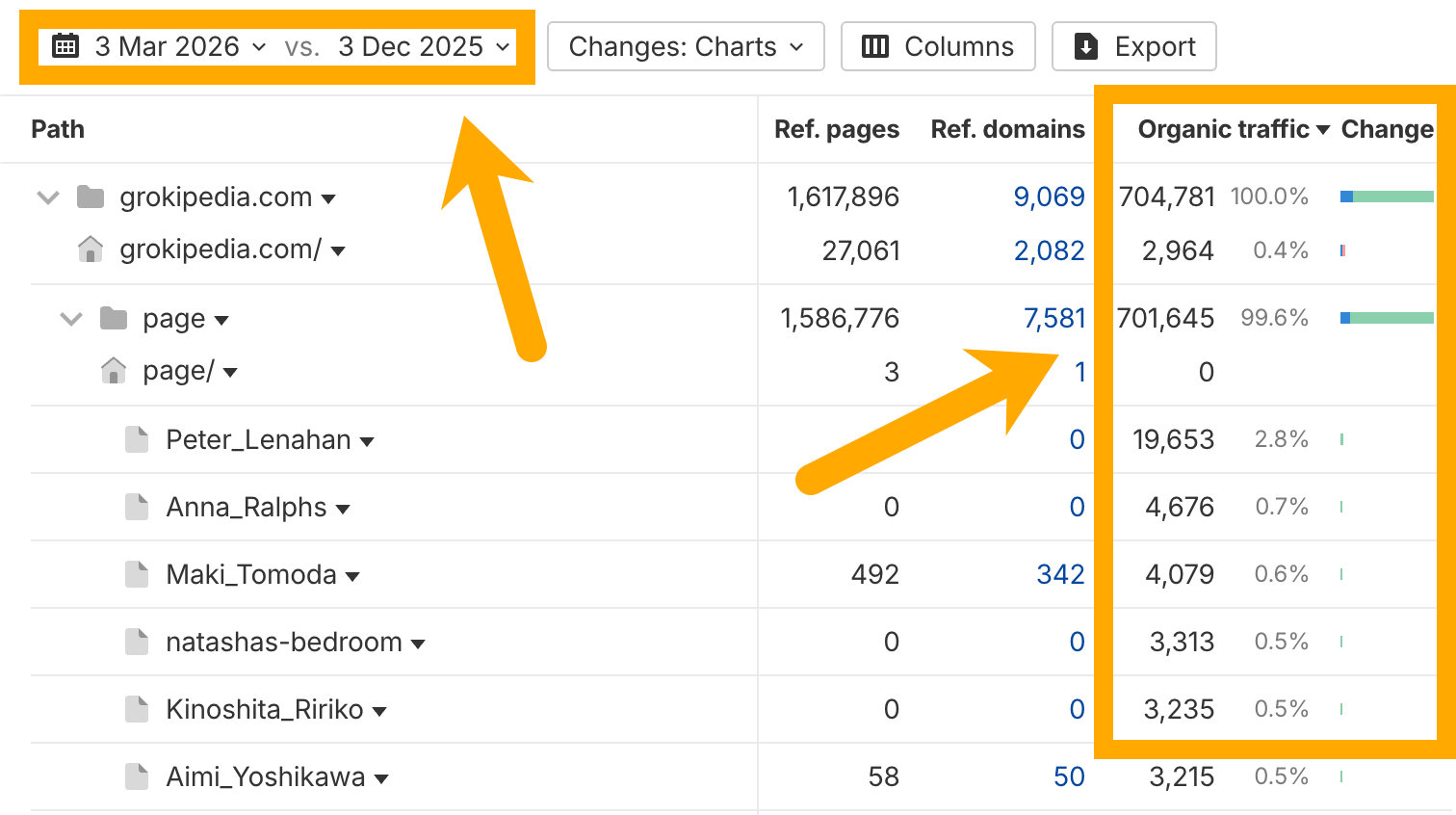
Use Site Explorer to analyze key performance metrics for virtually any domain: pages, estimated organic traffic, links and referring domains, AI content usage, and much more.
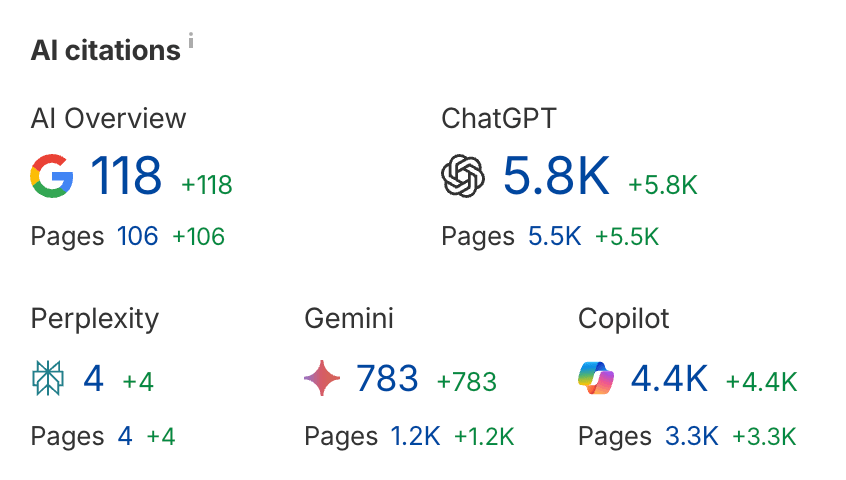
By contrast, ChatGPT seems to have a relative bias against citing Wikipedia, but no such issue with Grokipedia.
Measure AI visibility for any domain
Ahrefs Brand Radar lets you search, filter, and export our massive database of millions of AI prompts and outputs, across AI Overviews, AI Mode, ChatGPT, Perplexity, Gemini, and Copilot. Discover how virtually any domain shows up in AI search:
Given that Wikipedia is a crucial source of training data for most LLMs, and Grokipedia is written entirely by generative AI, I wanted to know: how similar are Grokipedia and Wikipedia pages?
To find out, we compared 10,000 “topic pairs”: pairs of Wikipedia and Grokipedia pages covering the same topic and referring to the same entity.
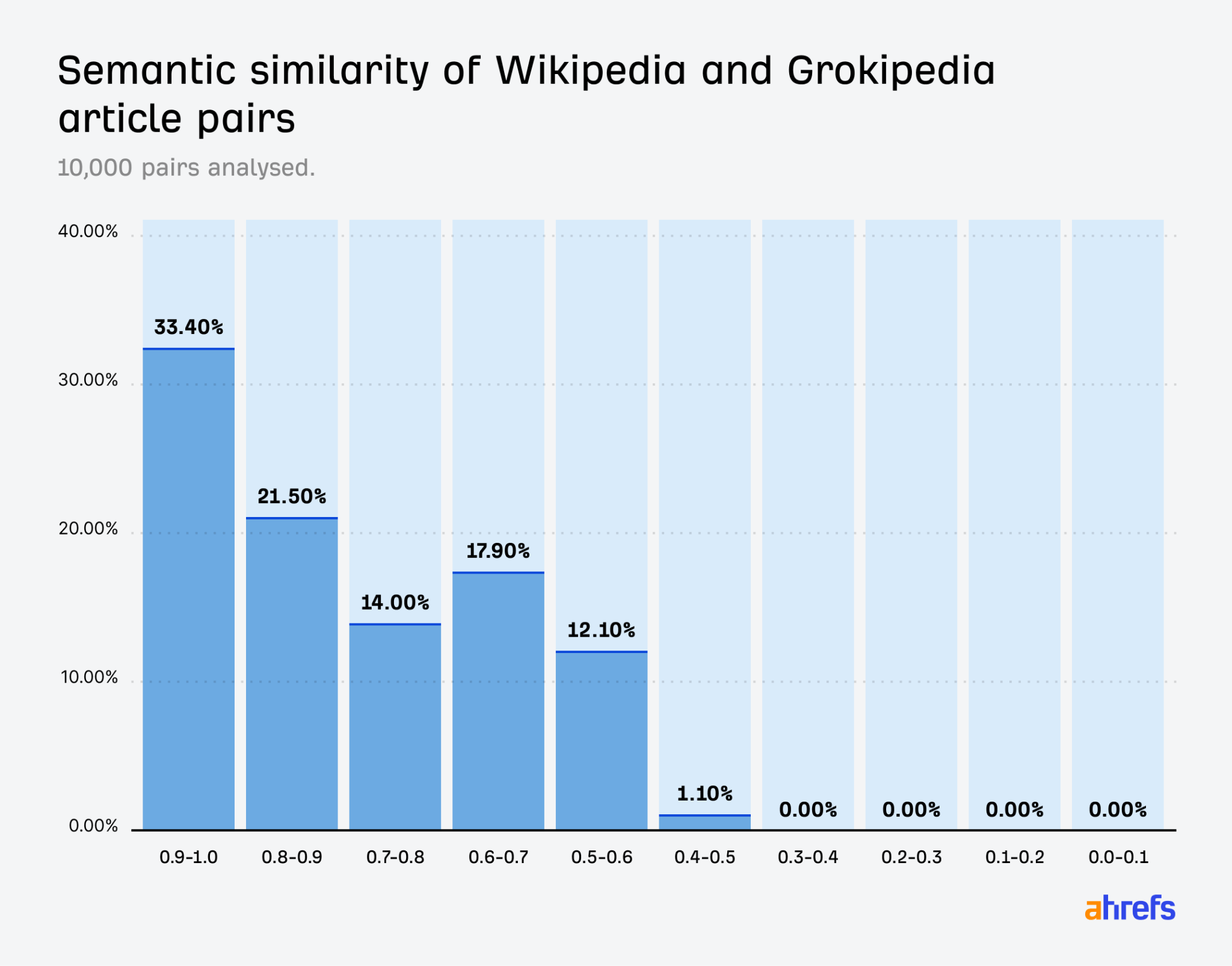
The mean semantic similarity of these topic pairs was 0.791, and the median was 0.831:
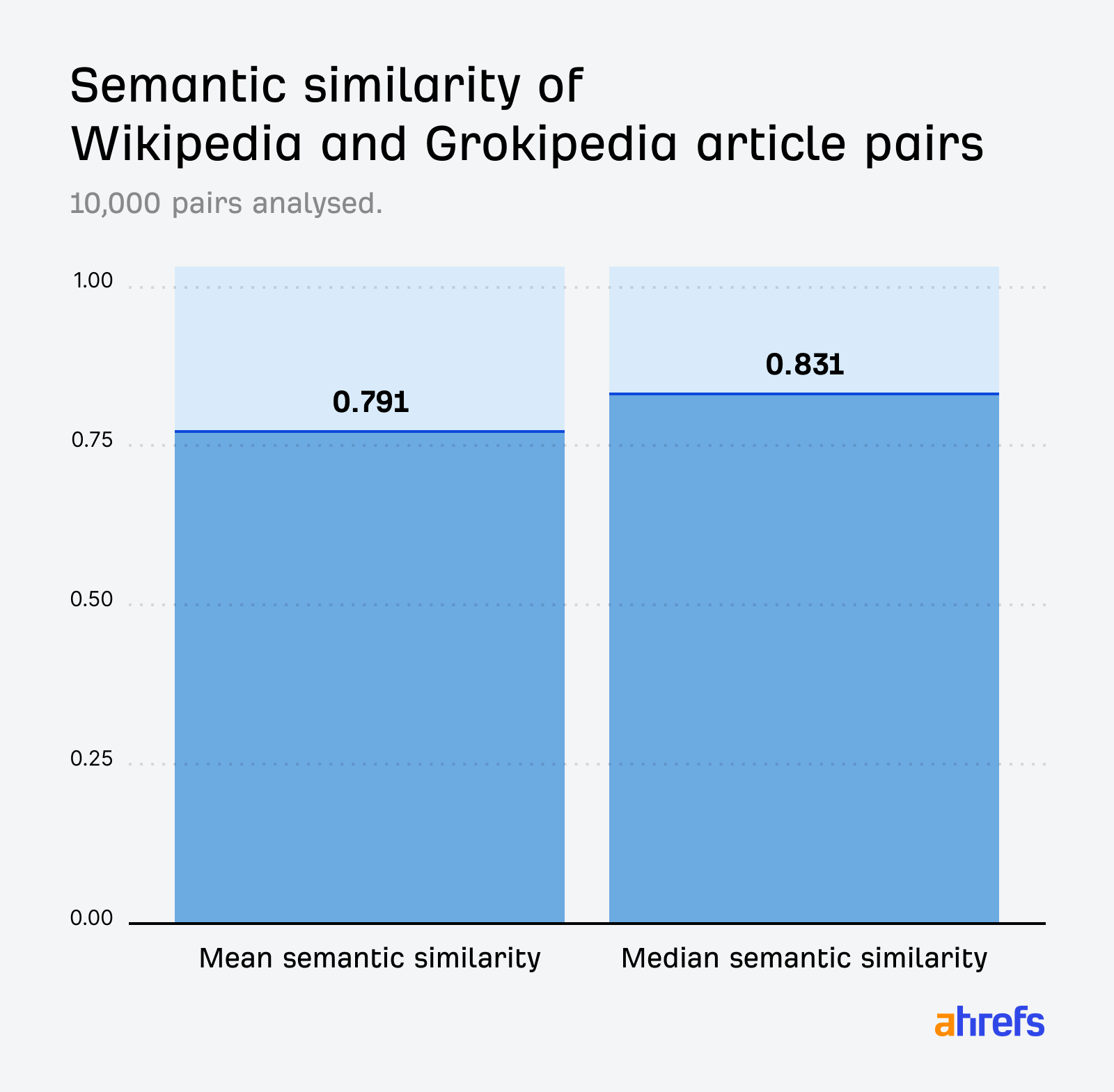
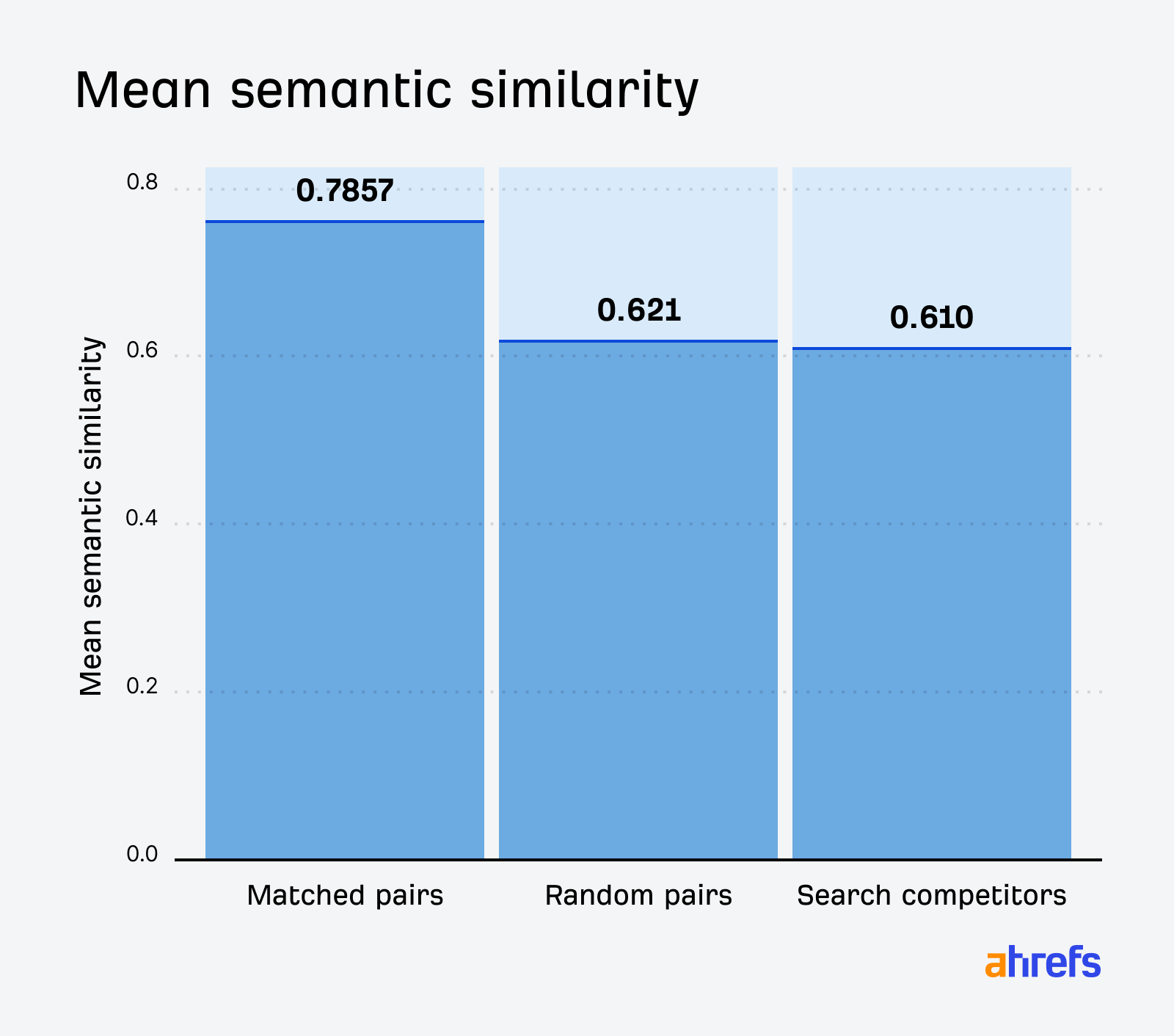
This is very strong semantic overlap. For context, if we take Grokipedia pages and compute their cosine similarity with random Wikipedia pages (that is, mismatched pairs), the mean cosine similarity is ~0.62.
Similarly, if we take other pages that rank for the same keywords as Grokipedia and Wikipedia pages, the average cosine similarity is ~0.61:
83% of the topic pairs we analysed had a cosine similarity greater than 0.62, indicating that Grokipedia pages share a very strong semantic overlap with Wikipedia pages describing the same entity:
Final thoughts
Grokipedia seems to represent a new model for wikis: AI-generated content designed for AI consumption.
Grokipedia has a relatively strong influence on AI citations, relative to its size, but a relatively weak influence on real people (as measured by estimated pageviews). Grokipedia pages are very similar to Wikipedia pages on the same topic, and it’s hard to avoid the image of the ouroboros eating its own tail. Certainly, the reading experience seems more intended for AI consumption than human.
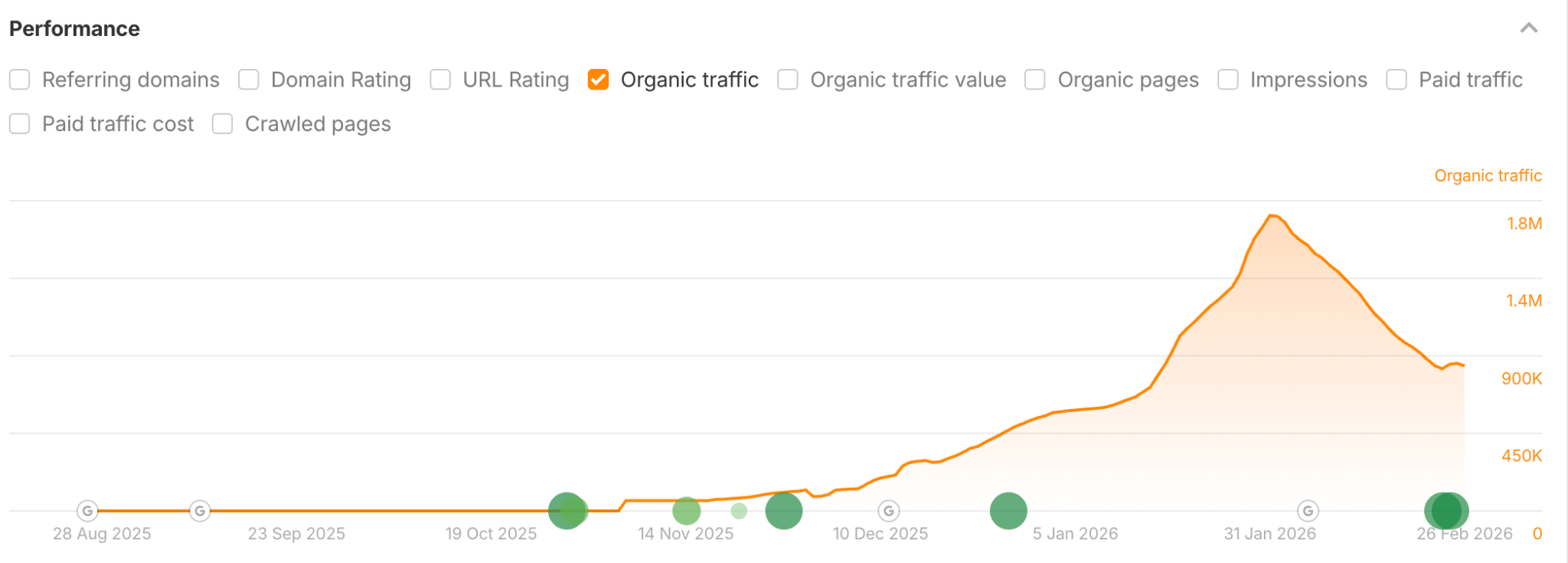
Ahrefs Site Explorer estimates that Grokipedia’s organic traffic has already fallen to half of its previous peak—so perhaps Google agrees with my assessment.
If you’ve got other ideas for Grokipedia analysis, let me know on LinkedIn.
Similar Posts
Top Benefits of Using Los Angeles Dedicated Servers for Your Business
When it comes to enhancing your business’s IT infrastructure, dedicated servers in the United States stand…
WPBeginner Spotlight 22: Big Milestones, Better Backups, and WordPress Community Tools
Welcome to Issue 22 of WPBeginner Spotlight! March was full of exciting developments in the WordPress…
AWS, Microsoft, Singtel Launch AUG East Cable to Boost AI Connectivity Asia
A major undersea infrastructure initiative is underway in East Asia as a consortium of global technology…
Shared Hosting to Enterprise Solutions: When Should You Upgrade?
In today’s hyper-connected digital economy, your web hosting infrastructure is more than a technical foundation—it’s a…
CleanSpark Partners with Submer to Build Sustainable AI Data Centers
CleanSpark, a U.S.-based Bitcoin miner and data center developer, has named Submer, a European leader in…