PPC keyword research is the process of finding the exact words or phrases people type into Google when they’re looking for something related to your product or service. It helps you target the right audience, avoid wasting money on irrelevant clicks, and attract people who are actually ready to buy.
When I asked experts for their #1 PPC tip for beginners (see my introduction to search ads), many said it’s smart to focus on keywords that are less popular, more specific, and cheaper. This guide will help you find those keywords, and avoid wasting money bidding on ones you already rank for organically.
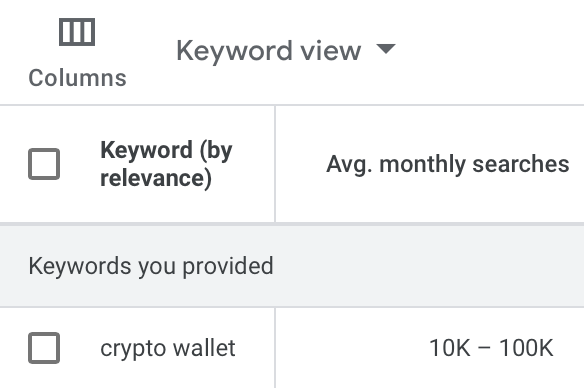
One downside of using Google Keyword Planner for PPC keyword research is that it often shows broad search volume ranges, which makes it hard to judge how popular a keyword really is.
For instance, for the keyword “crypto wallet” it shows a broad range of 10k-100k searches.
Tools like Ahrefs (that’s us!) can give you a clearer picture of a keyword’s popularity, making it easier to choose and prioritize the right ones for your campaign.

The Keyword Planner also tends to group similar keywords together, which can result in vague or overly broad suggestions that don’t reflect what people are actually searching for, especially when you’re looking for long-tail or niche keywords.
On top of that, the tool doesn’t provide data on your competitors, so you can’t see who’s bidding on which terms or how tough the competition is. All of this makes it harder to find precise, low-competition keywords that are actually worth your ad budget.
That’s where a combo like Ahrefs and ChatGPT really shines.
With Ahrefs, you can find more keyword ideas, get more precise volume estimates, and paid keyword reports for any competitor’s domain, and even translate for other markets on the spot.
Then, with ChatGPT, you can quickly filter, cluster, and prioritize those keywords based on business value, search intent, or even funnel stage.
In this guide, you’ll learn how to put this process into action step-by-step.
Let’s start with a few broad keywords related to your business (seed keywords). You can brainstorm some yourself and use Ahrefs’ built-in AI to help expand the list.

Next, go to the Matching terms report. Make sure you’re looking at results for the country where your core audience is. If you’re planning on running international or multilingual campaigns, we will translate the keywords in the following steps.

Exclude keywords where you rank in the top 10 and select intents: commercial and transactional. The two intent types typically mean the searcher is close to making a purchase. You can also filter out expensive keywords using the CPC filter.

If you’re not sure how much you should pay for a click, you can figure out your maximum CPC with some simple math:
- Using product price. Max CPC = (Product price x Profit margin x Conversion rate)
- Using your max budget and expected number of conversions. Max CPC = (Budget x Conversion rate)/ Expected number of conversions
Finally, select all keywords and add them to a new keyword list.

Tip
If your organic rankings are close to the top 10, you can optimize your content to move up. But you could also bid on those keywords in the meantime. Since you already rank for them, your ads will likely get a higher relevance score.

Add the results to your keyword list. Repeat for each competitor.
Tip
Here at Ahrefs we’ve just released the Paid Keywords 3.0 report. It shows which ads your competitors ran over the past month. Use it if the regular Paid Keywords report doesn’t return enough ads or whenever you want a broader view from the start.


Similar Posts
cPanel vs Plesk: Which Server Management Panel Should You Choose?
In today’s digital landscape, choosing the right server management panel is pivotal for businesses aiming to…
I’ll Show You How to Add Weight Based Shipping in WooCommerce
Unexpected shipping costs are one of the biggest reasons customers abandon their carts. If your WooCommerce…
Connectbase Launches Linkbase for Automated Partner Approvals
Connectbase has introduced Linkbase, a new feature within its Connected World platform, designed to automate and…
Aligned’s Phoenix Data Center Earns Three Green Globes Certification
Aligned Data Centers has earned a Three Green Globes certification from the Green Building Initiative (GBI)…
Supporting Messaging Based AI Agents with Optimized Server Infrastructure
A messaging agent can work well in testing, then become inconsistent once it starts handling live…
11 Best WordPress Payment Plugins (Tested & Verified)
When I first tried to accept payments on my WordPress website, the process was frustrating. Hours…